
When Boston Banned Christmas: The Five-Shilling Fine
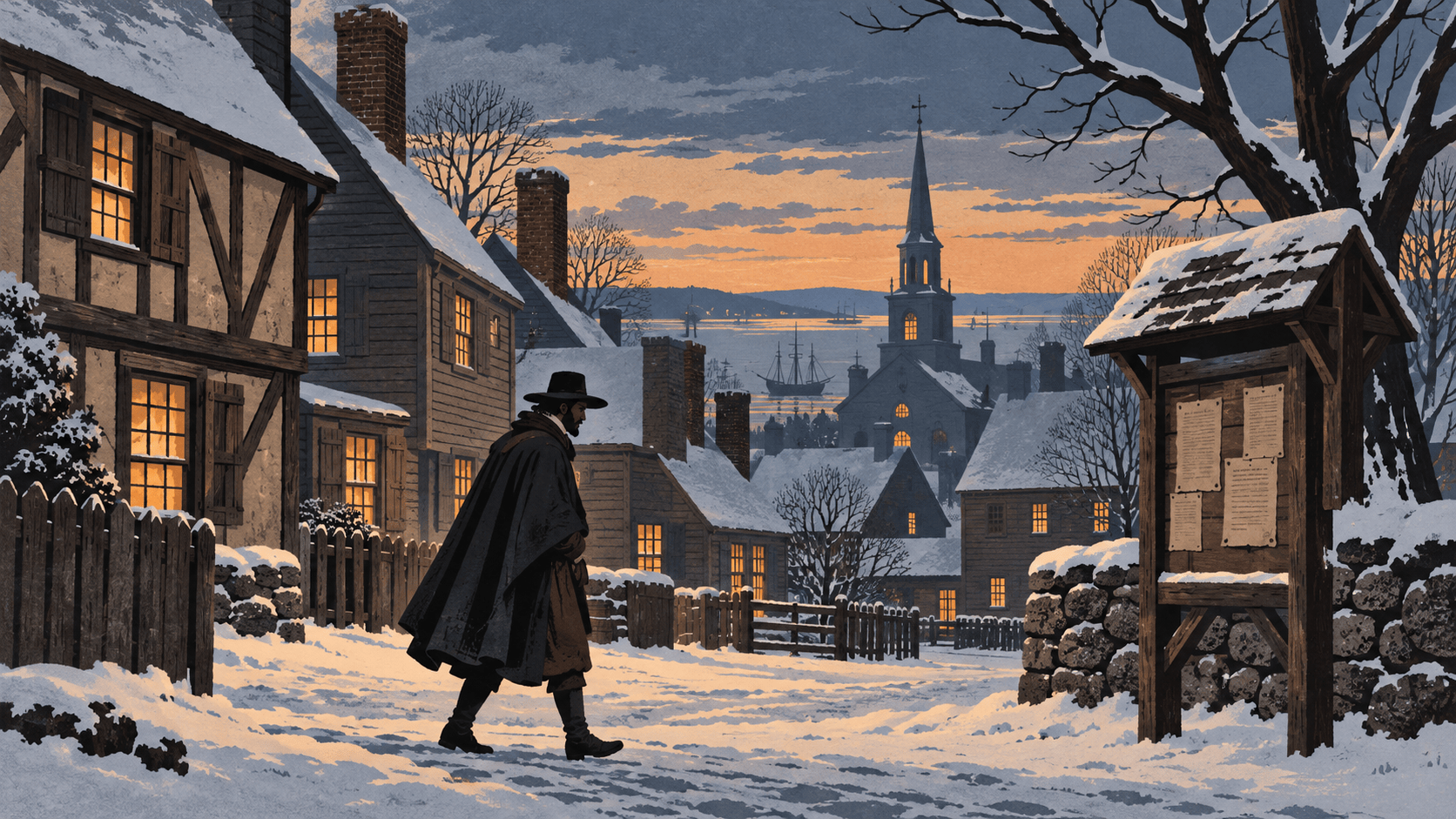
Imagine getting written up for taking Christmas off. In 1659, Massachusetts made certain Christmas observances punishable by a five-shilling fine, and the rule remained in place until 1681. The story is more interesting than a simple “Puritans hated fun” headline: it sits at the crossroads of theology, public order and the way early Boston tried to organize everyday life.
What did the 1659 law prohibit?
The law targeted people who marked Christmas by refusing to work, feasting or observing the day in another way. The penalty was five shillings for each offense. That is the useful detail: officials were not just declining to put Christmas on a civic calendar. They were telling residents how the day should be spent.
The rule applied across the Massachusetts Bay Colony, not only within today’s Boston city limits. Still, Boston was its political and commercial center, and the law is part of the city’s early story. The Commonwealth’s overview of the 1659 law records its stated rationale, while Harvard Divinity School’s interview with historian David F. Holland explains the thinking behind it.
Five shillings was a specific legal penalty, not a modern dollar amount that can be cleanly translated. Prices, wages and currency systems were different, and a direct conversion would imply a precision historians cannot claim. The lasting point is the law’s reach into ordinary routines: whether a person worked, ate a feast or treated December 25 as a special day.
The Puritan argument was religious and practical
Puritans believed that religious practice should follow what Scripture authorized. Christmas was not prescribed in the Bible, and some Puritan leaders saw the holiday’s customs as carrying Catholic or pre-Christian traditions. That theological objection mattered on its own.
There was also a practical concern. Christmas celebrations in England could involve feasting, drinking and rowdy public behavior. Holland describes the holiday as associated with social disorder and a temporary reversal of normal roles. Massachusetts leaders valued discipline and industriousness, so a day organized around public revelry landed squarely in the category they wanted to control.
It is tempting to picture every colonist agreeing with the policy, but the rule tells us more about the government’s position than every person’s private feelings. Communities include skeptics, quiet celebrants and people who would rather get through the day without a fine. Colonial records are not a group chat, unfortunately, so historians have to be careful about assigning one opinion to an entire population.
Christmas came back by changing the political weather
The ban ended in 1681, when the colonial government was pressured to suspend laws that conflicted with the Crown’s authority. The return was gradual in cultural terms. Ending a law did not instantly make holiday customs popular across Massachusetts, and New England held onto a more restrained relationship with Christmas for generations.
That long transition is part of what makes the story worth remembering. Boston’s identity was never one simple thing. The city’s public life was shaped by religion, commerce, migration and arguments over who got to set the rules. A holiday law gives us a vivid little window into those larger forces.
The story also reminds visitors that familiar traditions can be surprisingly recent, contested or regional. A December visit today takes place in a city full of seasonal music and lights, but those customs sit atop centuries of debate about public life. That contrast gives the season some historical texture without requiring a lecture before dessert.
From a rulebook to the tavern door
The same city that once tried to regulate a December day later became famous for lively public debate in taverns, meeting rooms and marketplaces. Boston’s taverns were part of the social infrastructure where news traveled and arguments gathered momentum. Those spaces and their stories sit close to the historic downtown route visitors explore today.
Boston Crawling’s Independence Pub Crawl makes that past easier to picture by pairing local stories with four bar stops near Faneuil Hall. The adults-only public tour runs daily at 3:00 p.m. and 7:00 p.m., plus noon on Saturdays and Sundays, and lasts 2 hours and 15 minutes. Guests must be 21 or older. Drinks are available for purchase separately at each stop. The guide meets the group at the Sam Adams statue, 6 Faneuil Hall Square.
See the Independence Pub Crawl details if you want a few more Boston stories with your evening out. Just remember: in 1659, the problem was not the date on the calendar. It was what authorities thought you were doing with it.